Ebook Free Austerity: The History of a Dangerous Idea
By beginning to read this book as soon as possible, you can easily discover properly making better qualities. Utilize your spare time to read this publication; also by pages you can take extra lessons and ideas. It will certainly not restrict you in some celebrations. It will certainly release you to always be with this publication whenever you will review it. Austerity: The History Of A Dangerous Idea is currently readily available right here and be the initial to obtain it currently.
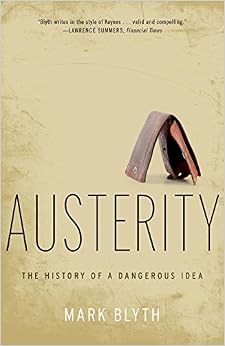
Austerity: The History of a Dangerous Idea

Ebook Free Austerity: The History of a Dangerous Idea
Austerity: The History Of A Dangerous Idea. The developed modern technology, nowadays support every little thing the human needs. It consists of the everyday tasks, works, workplace, entertainment, as well as a lot more. One of them is the wonderful net link and also computer system. This condition will relieve you to support among your leisure activities, checking out habit. So, do you have going to read this publication Austerity: The History Of A Dangerous Idea now?
When Austerity: The History Of A Dangerous Idea is attended to you, it's clear that this publication is extremely compatible for you. The soft file principle of this also brings ease of just how you will certainly appreciate the book. Certainly, enjoying guide can be just done by analysis. Reviewing the books will certainly lead you to always recognize every word to write and also every sentence to utter. Lots of people in some cases will certainly have various means to utter their words. Nevertheless, from the title of this publication, we're sure that you have recognized just what anticipate from the book.
Asking why? You have seen that this site has plenty of wonderful books from alternative releases a collections on the planet. Obtaining a minimal edition publication is also very easy below. You can discover Austerity: The History Of A Dangerous Idea, as example to be your turn and your choice now. Due to the fact that, we will not hide anything about it right here. We offer you all the most effective from Austerity: The History Of A Dangerous Idea that the author developed specifically for you.
Well, reading this book is not kind of difficult thing. You can only set aside the time for only few in away. When waiting for the list, waiting for someone, or when gong to the bed, you can take this book to read. Never worry, you can save it into the computer device or save it in your gadget. So, it will not make you feel hard to bring the book everywhere. Because, the Austerity: The History Of A Dangerous Idea that we provided in this website is the soft file forms.
Product details
Paperback: 336 pages
Publisher: Oxford University Press; Reprint edition (January 2, 2015)
Language: English
ISBN-10: 0199389446
ISBN-13: 978-0199389445
Product Dimensions:
8.4 x 1.1 x 5.5 inches
Shipping Weight: 13.6 ounces (View shipping rates and policies)
Average Customer Review:
4.2 out of 5 stars
115 customer reviews
Amazon Best Sellers Rank:
#152,122 in Books (See Top 100 in Books)
Austerity: The History of a Dangerous Idea is an overview of the history of austerity economic policy, an explanation of how austerity as a policy works (or, more accurately, does not work), and an examination of austerity policies as they have been implemented in the real world. As one can surmise from the book's subtitle, Blyth does not hold a rosy view of austerity as a policy but, though his disdain is clear, he still treats the idea with fairness throughout the book.What I most appreciated about Austerity was the way that most chapters (with the exception of the introduction and conclusion) was set up a bit like a textbook. The intent of the internal sections was to convey information and examine the scholarly research regarding austerity economic theory in light of criticism from other economists and - mainly - actual economies. However, Blyth took pains to make this information as accessible as possible to readers with little/no finance background by clearly explaining what measures meant and why things were important in the context of their real-world implications. I probably could have gotten more out of the analysis if I came to the book with a background in finance or math, but Austerity was understandable and highly educational nonetheless.
I really enjoyed this book; it summarized the debates about austerity for me and taught me a lot of things I didn't know about European austerity. I was aware of Keynes' The Economic Consequences of the Peace after WW I, for example, but not aware of how much the French at that time counted on reparations from Germany to heal their war-torn economy, while also trying to return to the gold standard. This led to French austerity, including cuts to their military while the Germans were inflating away their debts and rearming.I only gave it 4 stars because some of the writing is awkward; it needs a better proofreader. Many sentences involve mixed metaphors and there seem to be a few that say the opposite of what the author really means to say. At several points the author talks about how austerity is good for us all, when it is plain from the wider context that this is not what he thinks at all. Phrases like this are just confusing while trying to digest technical information about banking and economics. The author should have put these things into quotes or used some other rhetorical device. Austerity is not good for us.I totally agree that you cannot run a democracy on the gold standard for very long.If a 2nd edition comes out that cleans up some of the murky writing, I would give it 5 stars.
I found this book the same as many other people did - first I happened upon a video of the author talking against Austerity (quite compellingly) and then looked him up and found there was a book. I think along with Debt: The First 5,000 Years by David Graeber, it is the most important recent book on economics that I've read. A brilliant book, all told, and a must read for anyone that is following the macroeconomic discourse and thinks something about it is just off.While I started reading this book back in May (5 months ago), shortly after I was impressed by the video, I struggled to make progress in reading it. It wasn't until I girded myself and read it without distraction in the last few days that I got anywhere with it. This is not because it's a bad book, or that it's badly written, but simply because in the roughly 300 pages it packs more important, conceptual information than your average text-book. I often paused and went off to read some of the references, or just sat and thought through some of the logic. That this proved rewarding makes it worthwhile.What I found refreshing was that this is more than just a book that talks in terms that are in vogue in the public discourse. Instead, it takes a holistic approach.The author starts in the first three chapters by recapping the Financial Crisis in the US and the Eurozone Crisis, and exposing the 'moral play' behind the public discourse about it as patently false.To wit, both were purely crises within the Financial Sectors, but with banks having become systemically important, when the mortgage/ asset bubbles burst, governments were left holding the bills. The author points out quite acidly that what is today being called a "Sovereign Debt" crisis on both sides of the Atlantic actually wasn't - and critically, still isn't that. It is a crisis whose descriptions suffer from a fallacy of composition - in a nutshell, the people that made the mess are not the ones cleaning it up; we are all instead berating governments (who didn't make it) to clean it up, not realizing that we will be the ones settling the bill!The next three chapters summarize the history of Austerity, beginning with the times when nation state concept was itself young, and the "State" meant actually the "King", and had to be tied down and was not to be trusted with spending public money. The author starts by talking about the work of John Locke, David Hume, and Adam Smith - the dawn of the idea of private property and capitalism, and traces a line from them to both John Maynard Keynes, and Joseph Schumpeter, as well as the Austrian school exemplified by Hayek and Von Mises. In so doing, he exposes the intellectual roots of not only the Angela Merkels and Paul Ryans of the world, but also of the IMF's "Washington Consensus" that has driven liberalization in India (credited incorrectly to Manmohan Singh). Interestingly, he also shows why he thought Austerity was "Dangerous" - he draws a dotted line from Austerity in post WW1 Europe to the opening of political doors for Fascism and Nazism.I found this to be the most illuminating portion of the book, especially when it points out that although Austerity ideas were completely discredited by the end of the Second World War (having been a contributory cause to the extension of the Great Depression) they made a comeback through what are called the "Enablers of Austerity" - Milton Friedman's Monetarism, Neo-liberalism with its independent Central Banks, and the IMF and the aforementioned Washington Consensus. This is the best explanation I've seen for the complete disconnect between reality and the American and European ideologues currently peddling the conservative agenda.The author delves then into the case studies that are cited in support of Austerity - various historical instances worldwide, and the delightfully named "REBLL" alliance (Romania, Estonia, Bulgaria, Latvia, and Lithuania) that blew up their "Debt Stars". He proceeds to demolish each case, or (to use terminology picked up from police procedurals) definitely, convincingly introduces reasonable doubt against these poster children of Austerity.Only at the very end does the book go from descriptive to prescriptive, where the author suggests that higher taxes on the (infamous) 1% and others in the high income bracket, along with "financial repression" defined as mandated holding of inflation-susceptible government bonds by the Financial Industry are potential ways to cure the ballooned Sovereign Debt (which the latter caused) without fiscal contraction. This prescription is beyond my ken to qualify as good or bad, but hey - the other guys are clearly not helping any, so I say it's worth a shot!
Austerity: The History of a Dangerous Idea PDF
Austerity: The History of a Dangerous Idea EPub
Austerity: The History of a Dangerous Idea Doc
Austerity: The History of a Dangerous Idea iBooks
Austerity: The History of a Dangerous Idea rtf
Austerity: The History of a Dangerous Idea Mobipocket
Austerity: The History of a Dangerous Idea Kindle